Showing posts with label production. Show all posts

Friday, 5 August 2011

The Production Meeting


Always, before submitting anything to an organisation or company, a good brain storming is needed.

I would love to say that this would take place in a funky diner with burgers, fries and a shake while the kids play double dutch and dance around the juke box. Of course, the reality is far more prosaic. Cups of tea, lots of paper and spider diagrams.

I am a huge fan of spider diagrams. While most people jerk off on charts, I see things through loops. I don't know how or why, it is just how my brain works. I blame being left handed for the fact that I see things this way, more in spaces, morerandom than through flowing charts and mediums which make me switch off. It is also a lot less logical to think this way, bu in the end, everything fits together

Spreadsheets - pah...and now, time to do my spreadsheets!

Thursday, 4 February 2010

Talk...

It's good to talk. Or talk is cheap? Nonetheless, the pre-production stage is fraught with conversation. Talk of one project, talk of another and so on. There are three projects I am currently pursuing, projects where I am in charge plus another which I have begun to collaborate on. Four projects of the year. Plus the one project in post-production, 'Amigos Amigos', which as a documentary has been very challenging to piece together. This has been a week of talk and the next week will be filled with more of the same. Talk. Discussion and bringing together of many people. Let us see how it all turns out...

Friday, 29 January 2010

A Pre-Production Week

It has been a busy week. Rushing about and talking with a lot of potential partners on my latest film venture. Unlike Jay and Kay Save the World, I want to expand the scope of this new film. I do not know exactly what will happen, but I am looking for external sources of funding. More importantly, I am putting together a complete plan from these initial stages right through to the distribution technique. That is the big thing, distribution. But the plan is coming together, slowly...

Thursday, 27 August 2009

The Evolution of a Clip

Just a small talk through on how a clip becomes part of a short film. I wanted to share this little bit of film amking, as with this clip (along with a lot of others), what you film is not necessarily what ends up as the final version on the big screen. Unfortunately, due to 'youtube quality', the colour corrections do not come out too great in this one...


Or watch the vid by clicking this line!

Thursday, 6 August 2009

Adventures in the TV set.

NTSC. Mmm. Looks like I have to deal with it as part of my distribution strategy. Hmm...

Friday, 3 July 2009

DVD Authoring

Managed to get an MPEG-2, now onto the DVD suite, as this one requires an actual proper authoring. Should prove interesting...

Monday, 23 March 2009

Mid way through Production...

Today marks the midway point of the production process. One more day of shooting and that is that, there is no more second chances, so it has got to be good next week. And so today is spent looking at 'the rushes', to see what has been shot so far, to get a rough edit done and so to take a look at what has to be done next week. After all, despite the many takes, a film only needs one to make it...

Saturday, 14 March 2009

Pre-Production

Hello, I'm back...in this blog I am going to tell you all about what a make-up artist has to do whilst in pre-production for a project.

When I have landed a job, and once the director has sent me a copy of the script, I print of the script and read through it, taking notes on any part in which I think they might need any special make-up requirements. The second step I take, is I arrange a meeting with the director and discuss any ideas he might have regarding any hair/make-up/wig requirements; as well as talking about my own ideas, which I have noted down next to the part on the script.

After the meeting; if there are any special products needed, I tend to go to Charles.H.Fox which is on Tavistock street in covent garden and buy the products needed for the shoot (always remember to keep the receipt to give to the director or producer so they will be able to reinburse you of the spenditure)

It is always easier for yourself if the director can send you any pics of the cast, that way you can create a face chart of the design according to the cast member/ character.

The last and final step...production, personally I always prefer to try and get to the location at least 15mins before my own personal call time, since I like to take my time setting up.

Tuesday, 3 March 2009

Running around Town

As you may have seen on this blog, I am doing a hell of a lot of pre-production. That means running around, doing crazy things and basically acting like a headless chicken. Meeting up with people a lot of the time involves a great deal of co-ordination and a lot of patience while waiting for the tube.

But I have to admit, I have never felt this sociable in ages...

Oh, and of course, I never forget my vlogging...

Friday, 27 February 2009

Post Production Blues or How to 'up' the DPI of your stills from 72 to 300

I am peeved off.

As a director, there are certain things I despise. One of them is a simple solution to a seemingly complex problem.

Note the following:


This is a sample of the rules I have to follow to enter a film festival. A seemingly simple proposition. To make sure my JPEG's have a resolution of 300 DPI. So I lift a few stills directly from the timeline of my editing suite.

And now I have this problem:
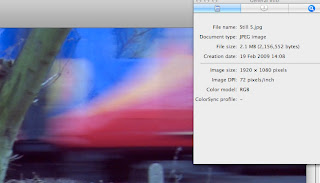


Yep, my stills read 72 DPI, despite the fact that the film was shot in HD.

Now, I'm racking my brains for a solution. I try tampering with the settings in my editing suite. I try different formats - PNG's, TIFF's, PICT's, anything! I try exporting Quicktime Stills, or anything else. I even try fiddling in Quicktime a completely different application Two whole days, I am banging my head.

The internet, normally the grapevine for such usefulness is basically hinting that I should buy an expensive photo editing suite - like hell I will!

So that is it, two day later, I am at a loss. Than in the corner of my eye, I spot a solution online:



I give it a try, and lo and behold, it works! Two frigging days for a relatively simple, if unorthodox procedure.

So, here is how you increase the DPI of your pictures so that it shows '300 dpi' instead of '72 dpi' to satisfy film festival regulations.

(If you follow the link, you will know for what operating system I am talking about, but like hell I will give those w**kers a direct plug by mentioning them in the blog).

---

1) Export the still from the editing timeline, in any 'still' format you want. I stuck to JPEG. Note that it will currently read '72 DPI' if you check the info of the file.

2) Open in Preview. Save as a PDF. Do not bother with any filters etc.

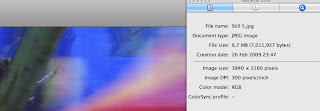
3) Open the PDF in Preview again. Save it as a JPEG. You will get the option to increase to the DPI, which is defaulted at 150 DPI. Type in 300 DPI.

4) You end up with exactly the same image, at the same dimensions, but now it satisfies the festival requirements and will read '300 DPI' when you check out the info for the file.


---

Now, I understand the festivals, why they want 300 DPI, as this is for their publicity, to make our films look good. What bugs me is that despite the multitudes you can spend on editing software, it does not do this automatically for you. I had to spend two days and follow an unrelated thread in order to find the solution to this problem.

After all, there are thousands of film makers, like myself out here in this world, who lift their stills off the editing time line and use it for their own publicity. Yet, the editing software, supposedly the 'one' that film makers use, the 'easy' option, cannot even export a JPEG to the standard dimensions demanded by film festivals.

For shame programmers - do you guys have a clue who your customers are?

Thursday, 26 February 2009

What the? El D is not happy...

What? This Pre-Production malarkey is getting to me. I am spending more time on London Transport than is deemed reasonable!

Damned city being so big! What next, another meet-up...oh yes, there is.

Well, I get to see a lot of London this way!

Wednesday, 25 February 2009

Pre 4: Rewrite the Script

My joy at all film making comes from the script writing. Getting at the script and hacking out a piece of flesh worthy of shooting upon. The script is the most important part a film. The storyboard is the guide, but the script is the blueprint. It is what launches a film and without a script then there is nothing to bother the film maker, actors or crew with.

A good script allows not only the film maker to visualise, but also inspires the musicians, the players on screen and the guys behind the camera.

Rewrites are important. The first draft is often an excited rendition of my mind's eye. So the rewrite is the clear crystal look at the script. Is it as good as I first thought (50-50 chance), how are the spelling and grammar of the script (my weak point), how cluttered is the dialogue (another fault of mine).

Once the rewrite is done, the script gets leaner, more punchy. When I first write something, the sheer telling of a story becomes important. But on the rewrites, it is the visualisation of the story that becomes the key. Telling the story not through words but through images. And that is why the rewrite is so important.

And yes, even a short film such as Jay and Kay save the World is rewritten. Especially in a short film, where every second counts, rewrites are essential in order to keep the audience transfixed on what I am trying to tell them. In a short film, you only get one shot at the audience...

Monday, 23 February 2009

Knuckle Down

One thing that is important in the pre-production stage is to knuckle down and get to it. So today, despite the thralls of nights kicking in, I am off to Tooting.

(But I will be half an hour late...)

Saturday, 21 February 2009

Pre 3: Storyboards

Oh yes, there is more than just the script. There are also the funky little stick men that I use to represent what I want on the screen. The script is a blueprint, the storyboards are a guide. Often the storyboards are changed last minute on the day, but they are essential to the workings of a good shoot...

And here is an example from my inner most workings:

Tuesday, 17 February 2009

Pre 2: Cast...

Meeting with the cst is important too. Well, a good director loves their cast. A bad one treats them like crap. Guess what type of director I am...

So later on today I will be meeting with half of the cast of CWP and I am organising another meet-up later on this week for the other half...

Monday, 16 February 2009

Working with 'Da Crew'

Yesterday's blog from Debra reveals a little of how many people are involved, even on a short film production.

Interestingly, I have worked with Debra for longer than any other person with regards to films. We started working together when I was just beginning to make films in 2004 and since then she has worked on almost every major production I have done, including the very first Caution Wet Paint which subsequently garnered my first taste of the film festival pie.

As a director, it is great to find people you get along with in a creative sense. It is also good to have people that think on the same wavelength as yourself. Having a good crew is essential to this. A good crew can read my mind, allow at me to shout at them and cover up for my mistakes. The crew are the silent sweethearts of the set. They do not appear on the screen, they do not get the inches of press dedicated to them, yet they are essential to the production of any film, big or small.

At the moment I am in the pre-production stage of the new Caution Wet Paint short. That means, meeting up with a lot of people. While I meet up with the cast and have regular chats with my El Maestro, I also meet up with the crew.

The crew know what their job is, but they are there to see the script, go over the storyboard and essentially familiarise themselves with what to do. Most things happen on the day, but a clued up crew knows exactly what to do and gets on with the job.

Expect to see more from both sides of the camera on this blog in the next few months...

Friday, 13 February 2009

'Pre' 1: The Script

A couple of weeks ago I was talking about the Post-Production process, but as Writer/Director/Producer, let me, Charles Michel Duke start at the beginning. Pre-Production.

The shoot will happen in March. That is, the shoot for Jay and Kay Save the World. And before anything starts, I have to solidify the script. Now, the problem between writing t and sitting on the script is that it changes. Not fundamentally, but it is the little changes. Already I have changed the words last night, and it will probably be tinkered with before I set it into production. But without the script itself, there is nothing...

Thursday, 29 January 2009

The Colours Continue

Well, the 'tripping' correction is now over', so I am off to the world of subtlety and the second colour correction, an enhancement rather than a straight change of the colours within the film.

The reason I went tripping on the first colour correction was to test out all the tools available. Now, on this more subtle one, I will use correction to enhance and add a richness to the colours within the picture. So there will be no artificial additions (if the hedge is brown and leafless with bark, then it stays that way) but improvements in the true colours themselves (red seems to do particularly well when 'spiced up').

I admit to being a super geek...

Wednesday, 28 January 2009

Butchering the Secondaries

(Before)


Now, I actually do not know what I am doing while I am correcting the colour for my short film. Which is why I have decided to go, for the first take, along the path of the 'butcher of brightness' and all such technicolour marvels. Luckily, being an experimental short in itself, I have taken some liberties with my first attempt at Colour Correction. By tonight I would have finished the 'butchered version' and then it will be onto the (much more difficult) subtle colour variation.

Anyway, Secondary Colour correction is much more detailed. Primaries affect the whole shot, secondaries, the part of the shot you want to affect, either a particular part, or if the shot is moving, a particular colour grain(s). It is more subtle, but distictly noticeable, especially when in HD:

After:


Anyway, enough geekery, I'm off to finish it off!